6 Reading Intervention Stations

Before I was an Orton-Gillingham tutor, I spent 10 years as a special education teacher and reading intervention teacher in public schools. In my last classroom, I had as many as 15-17 students in a single class, all reading at different levels — some students were brand new to English and just learning to read, while others already had solid fluency and simply needed support with comprehension.
That range taught me how to differentiate without losing my mind trying to do a million things at once. Below are six no-computer-required stations that were easy to set up, kept my students engaged, and made differentiation genuinely manageable — even on my busiest days.
Want these exact resources? Find them here: Suffix Worksheets
1. Word Sort

This is probably the station you're most familiar with: students get a list of words, then cut and sort them based on a shared pattern. In my example, students sort words by suffix (-er vs. -est), but you can build a sort around any skill — digraphs, blends, vowel teams, whatever your students need.
The differentiation trick: if you want to group students who are working on different skills at the same station, just give them different word sort sheets. For example, one student might work on suffixes while another works on basic digraphs — same activity, different content. As long as you write each student's name on their own sheet, the station stays organized even with multiple skill levels running at once.
2. Vocabulary Station

This station doubles as light spelling practice. I kept it simple with two printable worksheets:
Matching activity: students match words to their definitions. If they need more support, let them use a dictionary or pair up with a partner.
Fill-in-the-blank: students complete sentences using target words, which reinforces vocabulary, spelling, and comprehension all at once.
As with the word sort, you can retarget either worksheet to any skill and label each version with a student's name to keep multiple levels running smoothly in the same station.
3. Decodable Passage + Comprehension

This station combines decoding practice with real comprehension work — especially important for older students (I taught middle school) who could often decode but still struggled to understand what they read.
Students read a short decodable passage and highlight target word types as they go — suffixes, short vowels, whatever you're targeting. That first read-through doubles as a quick decoding check. Then they do a second read-through to answer comprehension questions.
Bonus tip: while you're floating between stations, have a student read the passage aloud to you and time it. That's an easy, built-in progress-monitoring data point without adding extra work to your day.
4. Early Finisher Station
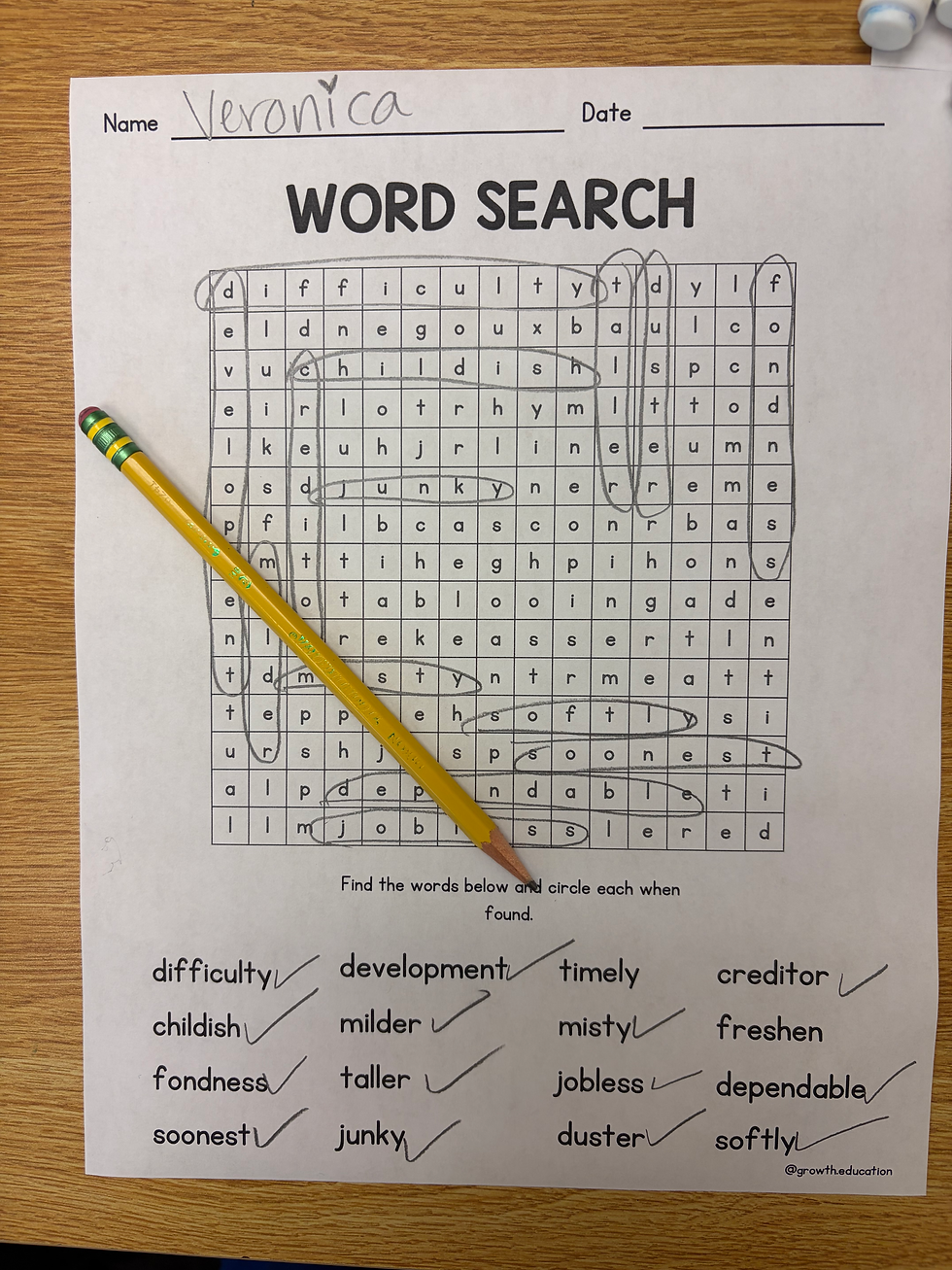
Every group finishes at a different pace, so I always kept an early finisher station stocked and ready. My go-to favorites:
Word searches — students rarely get tired of these. For extra motivation, add a "Wall of Fame" for anyone who finishes.
Coloring pages (see below)
Like the other stations, once students know the procedure — find target words, highlight the target word part, write sentences using the words — you can hand out individualized sheets and they'll know exactly what to do.
5. Coloring Station

Some kids love games and word searches; others love coloring. I built coloring worksheets around the same target skills — for example, coloring in a specific suffix within a word, or coloring sections of a picture based on which suffix a word contains.
These are especially useful for students with visual discrimination challenges, since the worksheet already does the visual isolation work for them, making the target word part stand out. This can work as a standalone station (just make sure you've got coloring supplies ready) or as another early finisher option.
6. Board Game

This was often a teacher-led small group activity, but it can absolutely run as an independent station too. I keep two versions on hand:
A blank version with flashcards for more basic skills
A morphology version, where students roll the dice, move their marker, and either read the word they land on or explain its meaning (for example: "oldest" = the most old, since -est is a superlative suffix)
Two tips for pacing:
If a group is running low on time, use the "exact number to finish" rule (players must roll the exact number needed to land on Finish) to naturally wind the game down.
If students finish early, have them write sentences using the words from the game as their early finisher task.
Putting It All Together
These six stations were my go-to setup because they were low-prep, easy to explain once and reuse endlessly, and flexible enough to serve a room full of students working on completely different skills. They work well in an ELA classroom, but they're especially useful in a reading intervention classroom, small group setting, or special education resource room where differentiation isn't optional — it's the whole job.
Next up: strategies for making station rotations run smoothly so they don't turn into chaos. Stay tuned!


Comments